
O processo de desconcentração e pulverização dos investimentos e a popularização do mercado de ações brasileiro pós 2001
DOI:
https://doi.org/10.16930/2237-7662/rccc.v9n26p45-61Keywords:
Bolsa de Valores, Clube de Investimentos, PopularizaçãoAbstract
Visando a ampliar o número de investidores no mercado de renda variável, foram criadas pela BOVESPA diversas ferramentas operacionais e programas educativos, que facilitaram a difusão e deram maior agilidade ao mercado de capitais. Entre estes, surgiram os clubes de investimentos que podem ser entendidos como associações voluntárias de investidores, os quais, de forma consorciada, realizam aplicações no mercado de capitais, administrando diretamente essas carteiras com a assistência e assessoria de instituições especializadas (bancos, sociedades corretoras, etc,). O presente trabalho tem por objetivo apresentar as mudanças ocorridas no processo de desconcentração do mercado e a pulverização dos investimentos ocorridos na BOVESPA, hoje BM&FBOVESPA, a partir de 2001, visando à popularização do mercado de ações no Brasil. Fará cumprir os objetivos, utilizou-se a pesquisa bibliográfica e a coleta de dados em órgãos do Banco Central do Brasil e na BM&FBOVESPA. O estudo mostrou que as mudanças recentes na bolsa levaram à inclusão de milhões de investidores minoritários, que até então desconheciam o mercado de capitais ou consideravam-no elitista e concentrado. Estas mudanças oportunizaram a estes investidores a possibilidade de obter mais rentabilidade que a oferecida pelos investimentos formais do mercado, embora com maior grau de risco. Atualmente, o mercado de capitais brasileiro está muito mais desconcentrado, pulverizado e popular do que já o foi e isto se reflete nos milhões de brasileiros, oportunizados e incluídos neste mercado. O número de investidores aumentou consideravelmente, assim como o número de clubistas e de clubes de investimentos.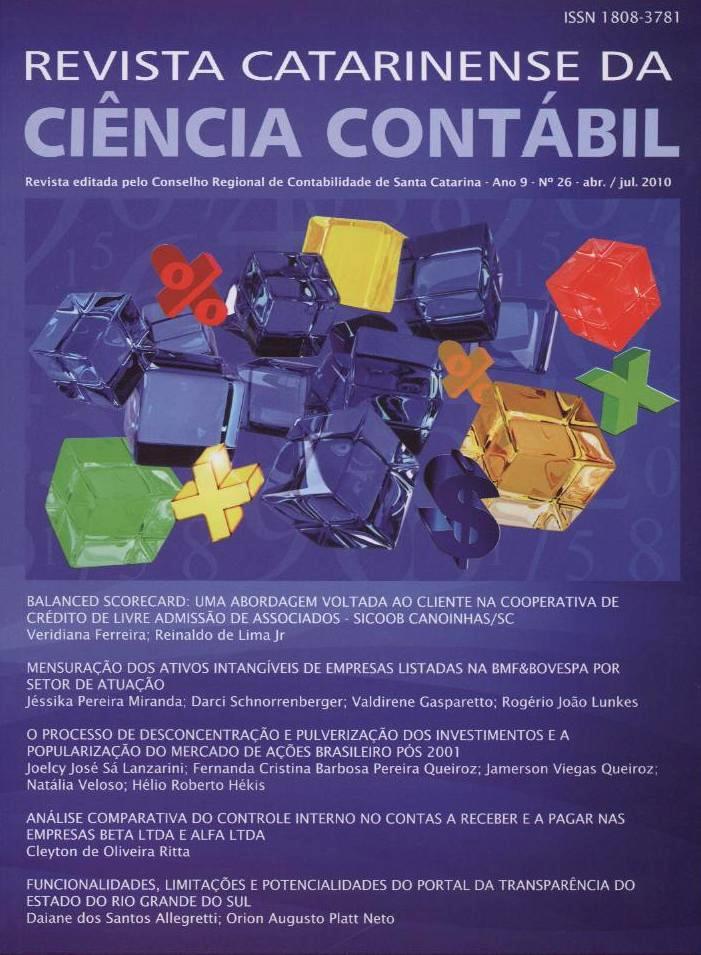
Downloads
Published
Issue
Section
License
Copyright (c) 2011 Revista Catarinense da Ciência Contábil

This work is licensed under a Creative Commons Attribution 4.0 International License.
Copyright of articles published in this journal remains with their respective authors, who grant the Revista Catarinense da Ciência Contábil (RCCC) the right of first publication.
Articles are published under the terms of the Creative Commons Attribution 4.0 International License (CC BY 4.0), which permits anyone to copy, distribute, reproduce, share, adapt, translate, remix, and use the work, including for commercial purposes, in any medium or format, provided that appropriate credit is given to the authors and to the original publication in RCCC, and any modifications made are clearly indicated.
Authors authorize the publication of their articles in the journal and declare that their contributions are original, unpublished, and are not under consideration for publication elsewhere.
RCCC reserves the right to make editorial, grammatical, stylistic, formatting, and standardization adjustments, provided that such changes do not alter the scientific content of the work.
The journal is not responsible for the opinions, ideas, methods, results, or conclusions expressed in the articles, which are the sole responsibility of their respective authors.
Authors also authorize the indexing, digital preservation, dissemination, and availability of their articles in databases, repositories, information systems, and other scholarly communication services, in accordance with the terms of the adopted license.

This work is licensed under a Creative Commons Atribuição 4.0 Internacional.















