
Fatores que contribuíram para a falência de uma indústria de componentes plásticos, coletados pela análise de relatórios contábeis
DOI:
https://doi.org/10.16930/2237-7662/rccc.v9n27p61-77Keywords:
Falência, Recuperação de Empresas, Análise das Demonstrações ContábeisAbstract
Em 2005 entrou em vigor no Brasil a Lei nº 11.101, também denominada nova Lei de Falência. Dentre as principais alterações implementadas pela nova Lei destacam-se a extinção da concordata, substituída pelo instituto da recuperação de empresa, e a conferência de uma maior importância aos relatórios contábeis. A presente pesquisa pretende responder à seguinte problemática: quais fatores coletados a partir das demonstrações contábeis contribuíram para a falência de uma indústria de plásticos localizada em Santa Catarina? O estudo se desenvolveu por meio da análise das demonstrações contábeis, da verificação dos laudos periciais e das entrevistas com o interventor judicial e com o advogado da empresa objeto do presente estudo. A metodologia, quanto aos objetivos, é descritiva, pois, pela análise dos relatórios contábeis, descreve fatores que contribuíram para a falência de uma indústria. Quanto a sua problemática, ao adotar a análise de tais relatórios, a pesquisa é de abordagem quantitativa-qualitativa. Em seus procedimentos, trata-se de um estudo de caso da Profiplast Industrial S.A. Por fim, conclui-se que os altos índices de endividamento e os procedimentos contábeis, em desacordo com a legislação vigente, foram fatores determinantes para a decretação da falência da Profiplast Industrial S.A.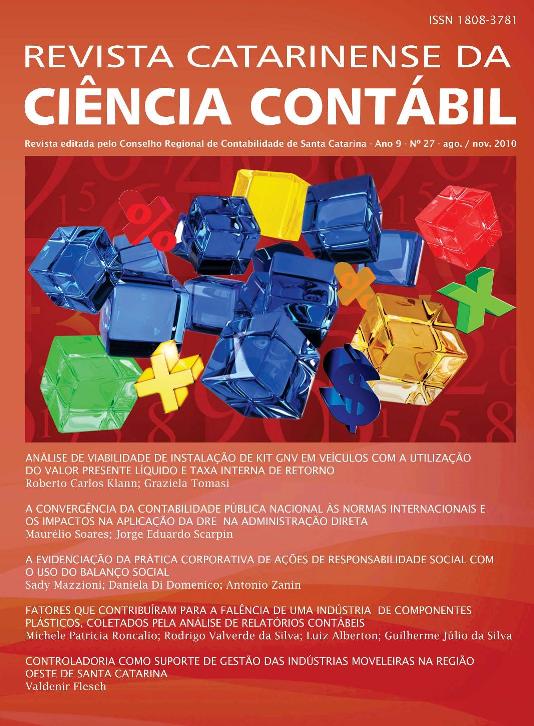
Downloads
Published
Issue
Section
License
Copyright (c) 2011 Revista Catarinense da Ciência Contábil

This work is licensed under a Creative Commons Attribution 4.0 International License.
Copyright of articles published in this journal remains with their respective authors, who grant the Revista Catarinense da Ciência Contábil (RCCC) the right of first publication.
Articles are published under the terms of the Creative Commons Attribution 4.0 International License (CC BY 4.0), which permits anyone to copy, distribute, reproduce, share, adapt, translate, remix, and use the work, including for commercial purposes, in any medium or format, provided that appropriate credit is given to the authors and to the original publication in RCCC, and any modifications made are clearly indicated.
Authors authorize the publication of their articles in the journal and declare that their contributions are original, unpublished, and are not under consideration for publication elsewhere.
RCCC reserves the right to make editorial, grammatical, stylistic, formatting, and standardization adjustments, provided that such changes do not alter the scientific content of the work.
The journal is not responsible for the opinions, ideas, methods, results, or conclusions expressed in the articles, which are the sole responsibility of their respective authors.
Authors also authorize the indexing, digital preservation, dissemination, and availability of their articles in databases, repositories, information systems, and other scholarly communication services, in accordance with the terms of the adopted license.

This work is licensed under a Creative Commons Atribuição 4.0 Internacional.















