
Avaliação da produtividade dos ativos: estudo de caso em empresa distribuidora de combustíveis
DOI:
https://doi.org/10.16930/2237-7662/rccc.v4n12p33-50Keywords:
Estudo de Caso, ROI, ROA, EVAAbstract
Em ambientes de competição acirrada, como os encontrados atualmente, cada vez mais os administradores têm sido exigidos no sentido de otimizar o retorno do capital investido pelos acionistas. Nessa direção, este artigo comenta sobre a relevância da avaliação da produtividade dos ativos e evidencia como isso pode ser efetuado pela utilização de três indicadores baseados em demonstrativos contábeis: ROI (Retorno sobre o Investimento), ROA (Retorno sobre Ativos) e EVA (Valor Econômico Agregado). Para tanto, após mencionar as razões pelas quais essa avaliação deve ser realizada, por intermédio de uma revisão da literatura, evidencia-se os conceitos relacionados, as possibilidades de cálculo, as vantagens e as limitações inerentes aos três parâmetros de análise em questão. Posteriormente relata-se, em detalhes, estudo de caso realizado em empresa que atua no segmento de distribuição de combustíveis, em que foram aplicados os três indicadores citados e interpretou-se os resultados alcançados no período, sob a óptica de cada uma. Conclui-se que a organização enfocada teve um desempenho inadequado no ano avaliado.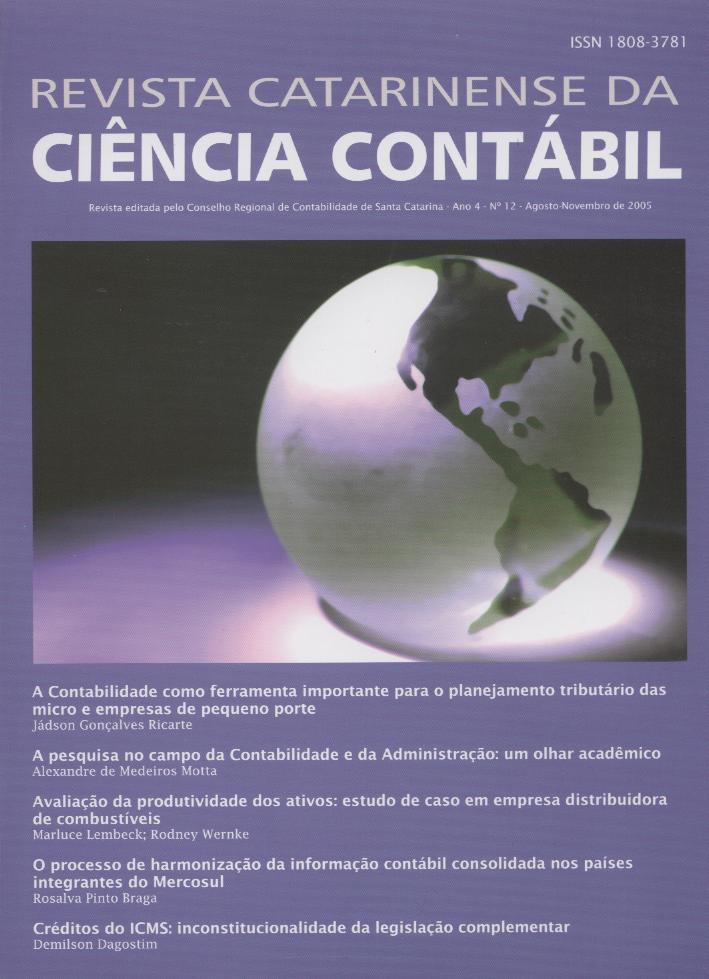
Downloads
Published
Issue
Section
License
Copyright (c) 2011 Revista Catarinense da Ciência Contábil

This work is licensed under a Creative Commons Attribution 4.0 International License.
Copyright of articles published in this journal remains with their respective authors, who grant the Revista Catarinense da Ciência Contábil (RCCC) the right of first publication.
Articles are published under the terms of the Creative Commons Attribution 4.0 International License (CC BY 4.0), which permits anyone to copy, distribute, reproduce, share, adapt, translate, remix, and use the work, including for commercial purposes, in any medium or format, provided that appropriate credit is given to the authors and to the original publication in RCCC, and any modifications made are clearly indicated.
Authors authorize the publication of their articles in the journal and declare that their contributions are original, unpublished, and are not under consideration for publication elsewhere.
RCCC reserves the right to make editorial, grammatical, stylistic, formatting, and standardization adjustments, provided that such changes do not alter the scientific content of the work.
The journal is not responsible for the opinions, ideas, methods, results, or conclusions expressed in the articles, which are the sole responsibility of their respective authors.
Authors also authorize the indexing, digital preservation, dissemination, and availability of their articles in databases, repositories, information systems, and other scholarly communication services, in accordance with the terms of the adopted license.

This work is licensed under a Creative Commons Atribuição 4.0 Internacional.















