
Desired profile of graduates of undergraduate accounting programs of the universities of Santa Catarina
DOI:
https://doi.org/10.16930/2237-7662/rccc.v12n34p40-52Keywords:
Profile of graduates, Skills and competencies, Accounting CourseAbstract
The objective of this paper is to analyze the profile of the undergraduate courses in Accounting from Santa Catarina universities. We sought to study the abilities, skills and required profile of graduates by Higher Education Institutions (HEI) in accordance with the Educational Course Programme (ECP), its relationship with the National Education Guidelines and orientations of the Federal Council of Accounting (FCA). The investigated sample consists of ten higher education institutions that offer graduation courses in Accounting and have a status of "university". The methodological procedures used characterize this research as exploratory and qualitative. The analysis results show that HEIs include in their ECPs desired skills and competencies, in line with national and CFC guidelines. The findings indicate that the HEIs investigated wish an accounting professional that has communicational and interaction skills with organizations and society, that is capable of dealing with information systems and that has interdisciplinary knowledge, who is able to present solutions to the challenges encountered when performing the profession and has a critical view. In addition, they expect this professional be a creative individual, updated, ethical and able to make the difference in context of integration.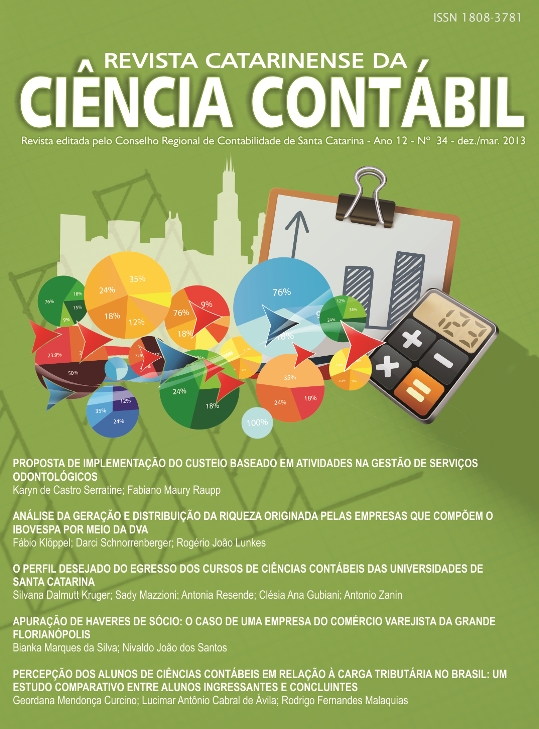
Downloads
Published
Issue
Section
License
Copyright (c) 2013 Revista Catarinense da Ciência Contábil

This work is licensed under a Creative Commons Attribution 4.0 International License.
Copyright of articles published in this journal remains with their respective authors, who grant the Revista Catarinense da Ciência Contábil (RCCC) the right of first publication.
Articles are published under the terms of the Creative Commons Attribution 4.0 International License (CC BY 4.0), which permits anyone to copy, distribute, reproduce, share, adapt, translate, remix, and use the work, including for commercial purposes, in any medium or format, provided that appropriate credit is given to the authors and to the original publication in RCCC, and any modifications made are clearly indicated.
Authors authorize the publication of their articles in the journal and declare that their contributions are original, unpublished, and are not under consideration for publication elsewhere.
RCCC reserves the right to make editorial, grammatical, stylistic, formatting, and standardization adjustments, provided that such changes do not alter the scientific content of the work.
The journal is not responsible for the opinions, ideas, methods, results, or conclusions expressed in the articles, which are the sole responsibility of their respective authors.
Authors also authorize the indexing, digital preservation, dissemination, and availability of their articles in databases, repositories, information systems, and other scholarly communication services, in accordance with the terms of the adopted license.

This work is licensed under a Creative Commons Atribuição 4.0 Internacional.















