
Accrual basis in Brazilian public sector studies: the mismatches of academic discussion
DOI:
https://doi.org/10.16930/2237-7662/rccc.v13n40p20-36Keywords:
Accrual basis, Accounting basis, Public sector accounting, NBC T SP.Abstract
The research on the adoption of accrual basis by the public sector in Brazil are few and fledgling, what is expected due to the scarcity of real study cases, because most federal entities have not adopted the accrual basis in it integral form yet. Despite of this, existing research represent the state-of-art of scientific knowledge on the subject and this research has sought to identify the Academy contributions to the understanding of accrual basis applied to the public sector in Brazil through a review of national studies that deal with the subject. There were selected articles that discuss accrual basis in the public sector from 2005 to 2012 published in periodicals and events punctuated by Capes related to accounting and/or public sector accounting. The results indicate that there is no stablished trend lines of research and the findings of one study does not tend to be compared with others. The searches have not been carried out forward, nor by other authors, or by themselves, and the authors have not exploited gaps left by previous searches, whether they are domestic or foreign. Comparisons between studies have also been affected, in some cases, due to methodological weaknesses. Thus, the Academy contributions to the understanding of the accrual basis applied to the public sector are rather fragmented, which can make it slow the progress in the subject.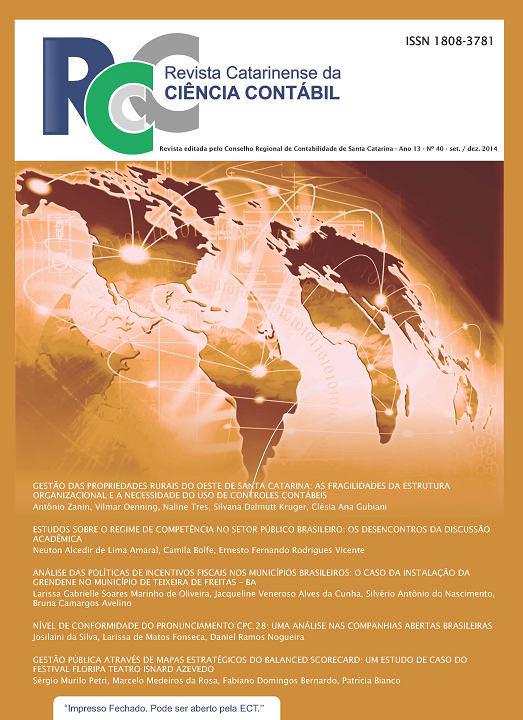
Downloads
Published
Issue
Section
License
Copyright (c) 2014 Revista Catarinense da Ciência Contábil

This work is licensed under a Creative Commons Attribution 4.0 International License.
Copyright of articles published in this journal remains with their respective authors, who grant the Revista Catarinense da Ciência Contábil (RCCC) the right of first publication.
Articles are published under the terms of the Creative Commons Attribution 4.0 International License (CC BY 4.0), which permits anyone to copy, distribute, reproduce, share, adapt, translate, remix, and use the work, including for commercial purposes, in any medium or format, provided that appropriate credit is given to the authors and to the original publication in RCCC, and any modifications made are clearly indicated.
Authors authorize the publication of their articles in the journal and declare that their contributions are original, unpublished, and are not under consideration for publication elsewhere.
RCCC reserves the right to make editorial, grammatical, stylistic, formatting, and standardization adjustments, provided that such changes do not alter the scientific content of the work.
The journal is not responsible for the opinions, ideas, methods, results, or conclusions expressed in the articles, which are the sole responsibility of their respective authors.
Authors also authorize the indexing, digital preservation, dissemination, and availability of their articles in databases, repositories, information systems, and other scholarly communication services, in accordance with the terms of the adopted license.

This work is licensed under a Creative Commons Atribuição 4.0 Internacional.















