
Identifying situations of tax avoidance and evasion: a study with accountants in the state of Santa Catarina - DOI: http://dx.doi.org/10.16930/2237-7662/rccc.v15n46p61-73
DOI:
https://doi.org/10.16930/2237-7662/rccc.v15n46p61-73Keywords:
Tax planning, Tax avoidance, Tax evasionAbstract
Tax planning is a way of minimizing tax costs without breaking the law, likewise, they are considered a differential among the financial services, representing a tax savings for different companies. But it is important to check what the quality and the knowledge of the person n charge of this practice is. The objective of this study is to verify the degree of accuracy of the accountants in omitted and evasive situations in tax savings. This study aimed to present practical situations of licit and illicit tax planning through a descriptive questionnaire with seven multiple-choice questions answered by accountants from different cities of the state of Santa Catarina. The questions were taken from studies in articles, court decisions, judgments and books, with the approach in tax planning for saving ISSQN and corporate reorganizations. The results presented by descriptive statistics show that most of the accountants understand practical situations of tax evasion. Within the degree of accuracy, this study points up to a percentage over 60%. In the average Student t test, it was noticed that the average between correct and wrong answers are different, that is, it can be said that the average of correct responses was greater. With the analysis of this percentage, the suggestion of this work is to tell the professional accountants that they must be always up to date on the aspects of tax law because there are constant changes and gaps for the correct interpretation of legal precepts.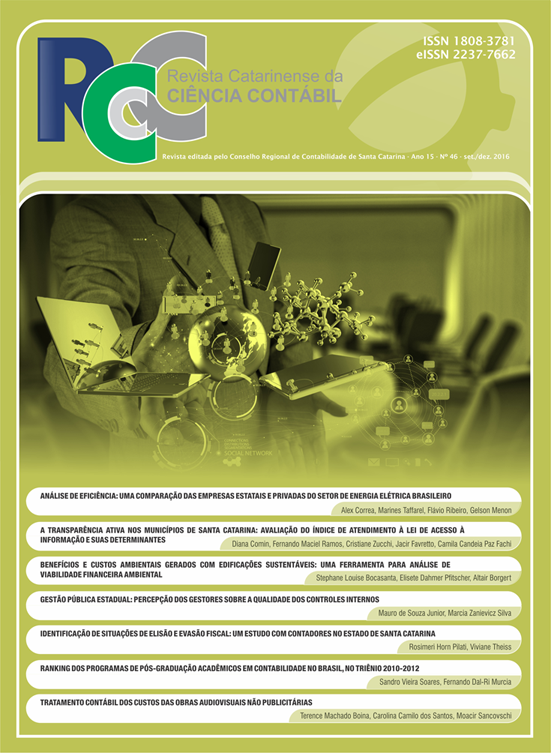
Downloads
Published
Issue
Section
License
Copyright (c) 2016 Revista Catarinense da Ciência Contábil

This work is licensed under a Creative Commons Attribution 4.0 International License.
Copyright of articles published in this journal remains with their respective authors, who grant the Revista Catarinense da Ciência Contábil (RCCC) the right of first publication.
Articles are published under the terms of the Creative Commons Attribution 4.0 International License (CC BY 4.0), which permits anyone to copy, distribute, reproduce, share, adapt, translate, remix, and use the work, including for commercial purposes, in any medium or format, provided that appropriate credit is given to the authors and to the original publication in RCCC, and any modifications made are clearly indicated.
Authors authorize the publication of their articles in the journal and declare that their contributions are original, unpublished, and are not under consideration for publication elsewhere.
RCCC reserves the right to make editorial, grammatical, stylistic, formatting, and standardization adjustments, provided that such changes do not alter the scientific content of the work.
The journal is not responsible for the opinions, ideas, methods, results, or conclusions expressed in the articles, which are the sole responsibility of their respective authors.
Authors also authorize the indexing, digital preservation, dissemination, and availability of their articles in databases, repositories, information systems, and other scholarly communication services, in accordance with the terms of the adopted license.

This work is licensed under a Creative Commons Atribuição 4.0 Internacional.















