
Benefits and environmental costs generated with sustainable buildings: a tool for environmental financial viability analysis
DOI:
https://doi.org/10.16930/2237-7662/rccc.v15n46p35-46Keywords:
Environmental benefits and costs, Sustainable buildings, Environmental feasibility of the projectAbstract
Due to technological and industrial growth, the demand for natural resources has been high, especially for the construction sector, accounting for considerable volumes of waste. However, the adoption of sustainable practices in the construction industry requires financial viability. In this context, the research aims to propose a tool for managing the environmental benefits and costs generated with sustainable buildings. To propose the tool, especially the third phase of the third stage of the Accounting Environmental Management System (SICOGEA) has been used as a base, adapting to sustainable construction, as the theme of literature. Regarding the methodological framework, we consider this research as descriptive, bibliographical and qualitative. Finally, it is concluded that the answer to the problem of this research was possible, since a tool that assists in the management of sustainable buildings was introduced, in order to verify to what extent the environmental benefits and environmental costs this project offers. In addition to assisting in analyzing the environmental and financial feasibility of this project, checking whether it should be accepted, revised or rejected.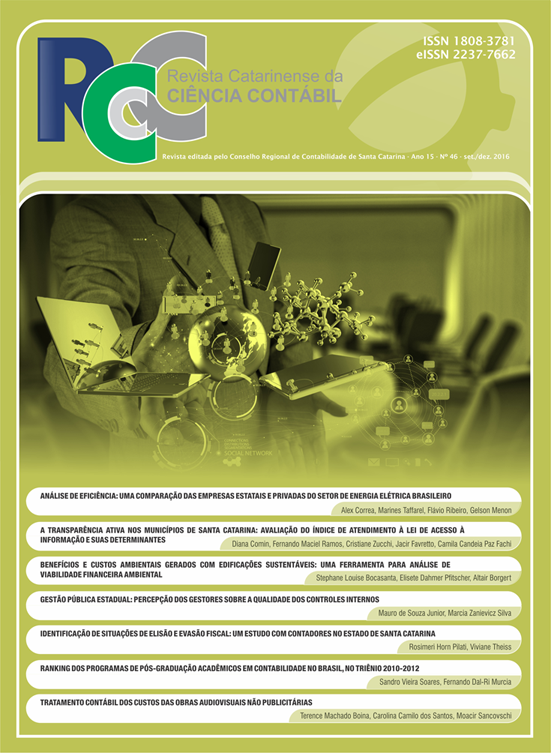
Downloads
Published
Issue
Section
License
Copyright (c) 2016 Revista Catarinense da Ciência Contábil

This work is licensed under a Creative Commons Attribution 4.0 International License.
Copyright of articles published in this journal remains with their respective authors, who grant the Revista Catarinense da Ciência Contábil (RCCC) the right of first publication.
Articles are published under the terms of the Creative Commons Attribution 4.0 International License (CC BY 4.0), which permits anyone to copy, distribute, reproduce, share, adapt, translate, remix, and use the work, including for commercial purposes, in any medium or format, provided that appropriate credit is given to the authors and to the original publication in RCCC, and any modifications made are clearly indicated.
Authors authorize the publication of their articles in the journal and declare that their contributions are original, unpublished, and are not under consideration for publication elsewhere.
RCCC reserves the right to make editorial, grammatical, stylistic, formatting, and standardization adjustments, provided that such changes do not alter the scientific content of the work.
The journal is not responsible for the opinions, ideas, methods, results, or conclusions expressed in the articles, which are the sole responsibility of their respective authors.
Authors also authorize the indexing, digital preservation, dissemination, and availability of their articles in databases, repositories, information systems, and other scholarly communication services, in accordance with the terms of the adopted license.

This work is licensed under a Creative Commons Atribuição 4.0 Internacional.















