
Efficiency analysis: a comparison of state and private companies in the electrical sector in Brazil - DOI: http://dx.doi.org/10.16930/2237-7662/rccc.v15n46p9-23
DOI:
https://doi.org/10.16930/2237-7662/rccc.v15n46p9-23Keywords:
Effiency analysis, State and private power industries, Financial and economical indicatorsAbstract
The electric power industry in Brazil has been through uncountable changes throughout the years, especially due to the privatizing of many state power industries in the 90's. This fact made the regulators of the sector act in the sense of trying to guarantee quality, continuity and access of these services to all population. Having in mind the massive participaton of private power companies in the electric power generation, this research has as its objective to verify whether there is difference in terms of economical and financial efficiency among private and state power companies from this sector. The methodological procedures used in this study are bibliographic and documental, with a quantitative approach on data. For that, after the construction of the accounting and the financial indicators, an analysis on the power company efficiency was carried out based on Data Envelopment Analysis (DEA). The results have shown that in spite of existing a differentiated oscillation in the efficiency coefficients in state power companies when compared to the private ones, such difference does not have any statistical significancy, indicating that state power companies as well as private power companies in Brazil show similar economical and financial efficiency.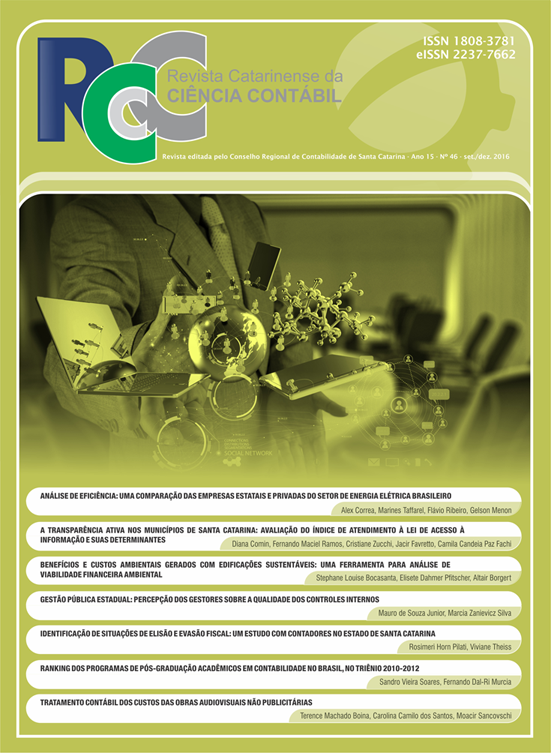
Downloads
Published
Issue
Section
License
Copyright (c) 2016 Revista Catarinense da Ciência Contábil

This work is licensed under a Creative Commons Attribution 4.0 International License.
Copyright of articles published in this journal remains with their respective authors, who grant the Revista Catarinense da Ciência Contábil (RCCC) the right of first publication.
Articles are published under the terms of the Creative Commons Attribution 4.0 International License (CC BY 4.0), which permits anyone to copy, distribute, reproduce, share, adapt, translate, remix, and use the work, including for commercial purposes, in any medium or format, provided that appropriate credit is given to the authors and to the original publication in RCCC, and any modifications made are clearly indicated.
Authors authorize the publication of their articles in the journal and declare that their contributions are original, unpublished, and are not under consideration for publication elsewhere.
RCCC reserves the right to make editorial, grammatical, stylistic, formatting, and standardization adjustments, provided that such changes do not alter the scientific content of the work.
The journal is not responsible for the opinions, ideas, methods, results, or conclusions expressed in the articles, which are the sole responsibility of their respective authors.
Authors also authorize the indexing, digital preservation, dissemination, and availability of their articles in databases, repositories, information systems, and other scholarly communication services, in accordance with the terms of the adopted license.

This work is licensed under a Creative Commons Atribuição 4.0 Internacional.















