
Teaching Entrepreneurship in Undergraduate Courses in Accounting Sciences
DOI:
https://doi.org/10.16930/2237-7662/rccc.v12n35p63-78Keywords:
Education, Entrepreneurship, Accounting SciencesAbstract
Nowadays, it appears that entrepreneurship has had an ever-increasing importance in the world, because of the many changes that have been taking place, especially in labor relations. Several countries have undertaken actions to include teaching entrepreneurship in their curriculum structures in primary, secondary and higher education, being aware that the entrepreneur is one of the elements that provide rising conditions of employment and income. Accordingly, the objective of this study was to identify if the culture of entrepreneurship is practiced in undergraduate courses in accounting sciences in major institutions of higher education in Brazil, focusing on federal universities. The research is characterized as descriptive and qualitative. The sample analysed involved twenty-seven federal institutions, and each of them represents a unit of the federation. As a result, it became evident that the issue of entrepreneurship is present as very incipient in educational projects of the institutions surveyed, but there is a trend towards the implementation in their syllabus strutures. It was concluded, finally, that further study is necessary, awareness and entrepreneurship dissemination on the part of public institutions of higher education for accounting sciences courses, to encourage the accounting professionals to develop their potential in supporting entrepreneurs and the development of the country.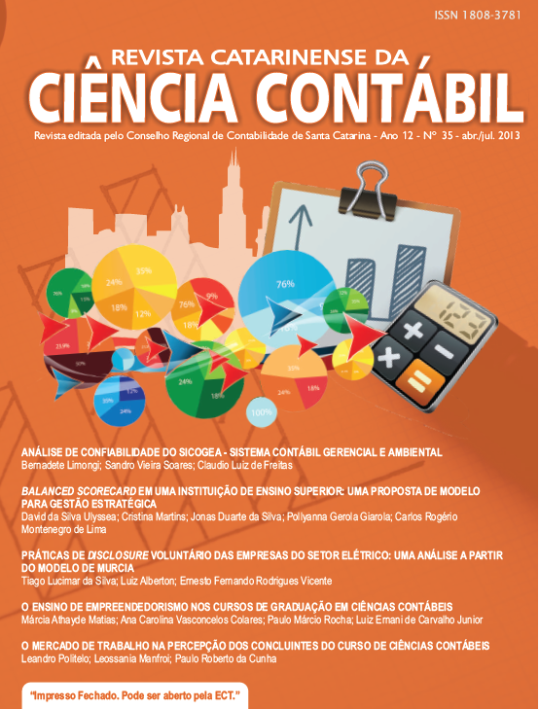
Downloads
Published
Issue
Section
License
Copyright (c) 2013 Revista Catarinense da Ciência Contábil

This work is licensed under a Creative Commons Attribution 4.0 International License.
Copyright of articles published in this journal remains with their respective authors, who grant the Revista Catarinense da Ciência Contábil (RCCC) the right of first publication.
Articles are published under the terms of the Creative Commons Attribution 4.0 International License (CC BY 4.0), which permits anyone to copy, distribute, reproduce, share, adapt, translate, remix, and use the work, including for commercial purposes, in any medium or format, provided that appropriate credit is given to the authors and to the original publication in RCCC, and any modifications made are clearly indicated.
Authors authorize the publication of their articles in the journal and declare that their contributions are original, unpublished, and are not under consideration for publication elsewhere.
RCCC reserves the right to make editorial, grammatical, stylistic, formatting, and standardization adjustments, provided that such changes do not alter the scientific content of the work.
The journal is not responsible for the opinions, ideas, methods, results, or conclusions expressed in the articles, which are the sole responsibility of their respective authors.
Authors also authorize the indexing, digital preservation, dissemination, and availability of their articles in databases, repositories, information systems, and other scholarly communication services, in accordance with the terms of the adopted license.

This work is licensed under a Creative Commons Atribuição 4.0 Internacional.















