
Controllers Performance Evaluation in Companies With Reward Compensation Systems - DOI: http://dx.doi.org/10.16930/2237-7662/rccc.v14n43p21-37
DOI:
https://doi.org/10.16930/2237-7662/rccc.v14n43p21-37Keywords:
Performance evaluation, Reward compensation, ControllersAbstract
The goal of this study is to identify the method of performance evaluation used for the controllers in companies that adopt reward compensation systems. Descriptive study was conducted with a survey, having as population the 58 companies located in Curitiba/PR members of the Center of Support to Innovation Management (Núcleo de Apoio a Gestão da Inovação - NAGI), program sponsored by the Financier of Studies and Projects (Financiadora de Estudos e Projetos - FINEP) and the National Council for Scientific and Technological Development (Conselho Nacional de Desenvolvimento Científico e Tecnológico - CNPq), conducted in the State of Paraná by the National Industrial Apprenticeship Service (Serviço Nacional de Aprendizagem Industrial - SENAI) of Paraná. The sample by accessibility consists of the respondents of the questionnaire, and descriptive statistics was applied to the collected data. The survey results show the characteristics of the companies' performance evaluation, controllers' remuneration composition, and the system of variable remuneration of the controllers. It is concluded that the method of performance evaluation mostly practiced by the sample companies that adopt variable compensation system is the participation in the profits, and that the motivation for its implementation from the point of view of the controllers is indifferent. This result instigates research to investigate to what extent the performance evaluation system can contribute to minimize the agency conflict from the perspective of freedom of the controllers in terms of hierarchical subordination.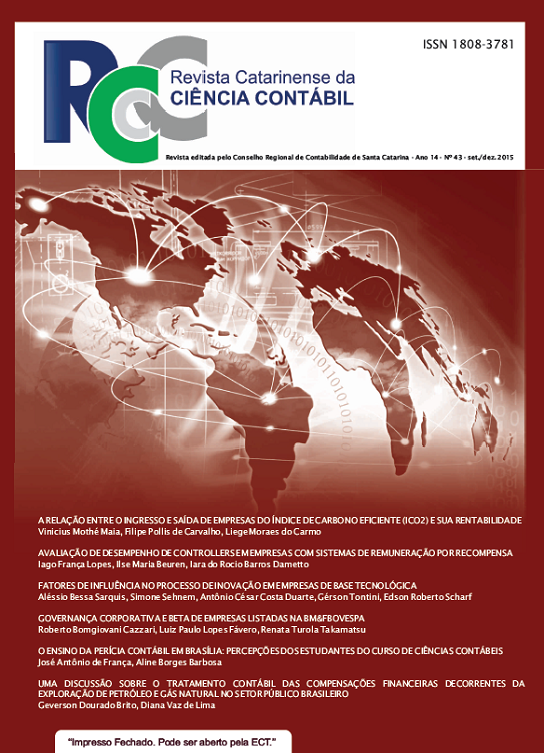
Downloads
Published
Issue
Section
License
Copyright (c) 2015 Revista Catarinense da Ciência Contábil

This work is licensed under a Creative Commons Attribution 4.0 International License.
Copyright of articles published in this journal remains with their respective authors, who grant the Revista Catarinense da Ciência Contábil (RCCC) the right of first publication.
Articles are published under the terms of the Creative Commons Attribution 4.0 International License (CC BY 4.0), which permits anyone to copy, distribute, reproduce, share, adapt, translate, remix, and use the work, including for commercial purposes, in any medium or format, provided that appropriate credit is given to the authors and to the original publication in RCCC, and any modifications made are clearly indicated.
Authors authorize the publication of their articles in the journal and declare that their contributions are original, unpublished, and are not under consideration for publication elsewhere.
RCCC reserves the right to make editorial, grammatical, stylistic, formatting, and standardization adjustments, provided that such changes do not alter the scientific content of the work.
The journal is not responsible for the opinions, ideas, methods, results, or conclusions expressed in the articles, which are the sole responsibility of their respective authors.
Authors also authorize the indexing, digital preservation, dissemination, and availability of their articles in databases, repositories, information systems, and other scholarly communication services, in accordance with the terms of the adopted license.

This work is licensed under a Creative Commons Atribuição 4.0 Internacional.















